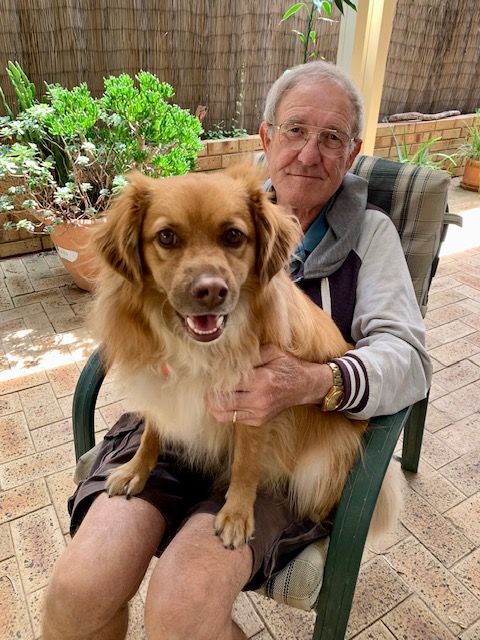
Ron Chapman, currently of Perth, Western Australia, has sent us an article about his time ringing in Blaby in the 60s, an excerpt of which I reproduce here:
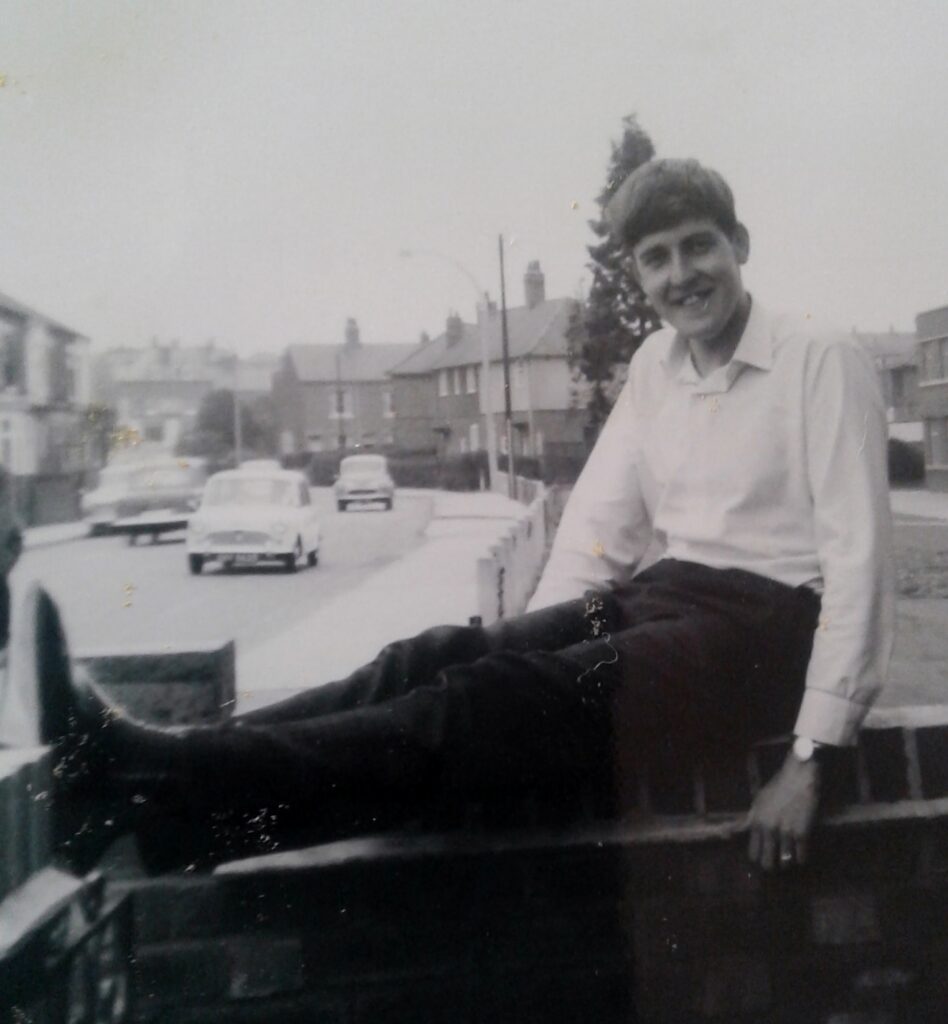
One of my classmates at Guthlaxton Grammar School in the early 1960s was a lad named Alan Ward. He was among a group of friends that I would hang around with during recess and lunch breaks. Alan lived near Blaby, a village about twenty minutes’ drive west of Wigston Magna, so he travelled to Guthlaxton by bus every day. He lived in an area called Glen Hills and his father was the Headmaster of Blaby Junior School, which was located next to All Saints Church.
One day Alan told me he had just started learning to ring the bells at the church and wondered if I would be interested in joining him. I thought it sounded interesting so I said I would go along. The ringing practices were held on Wednesday evenings, so each week I would catch the L15 bus from outside my home or cycle to Blaby. My mother was surprised when I told her I wanted to learn how to ring church bells, but was glad I had found another interest.
I think I had my first bellringing lesson in late-1961, although I cannot fix the date with absolute certainty. When I started ringing at All Saints, Blaby, the tower had a ring of five bells, with a 10 cwt tenor. At that time the ringing room was on a first floor level, which was reached by means of a fixed ladder in the corner of the room at the base of the tower and then up through a trapdoor. In more recent times the bells have been augmented to a ring of six.
I will never forget my first lessons in bell handling because everything seemed so chaotic! When the ringing chamber was on the upper floor the room was so much smaller, so everyone had to squeeze themselves against the walls while five ringers were standing around in a circle trying to ring the bells.
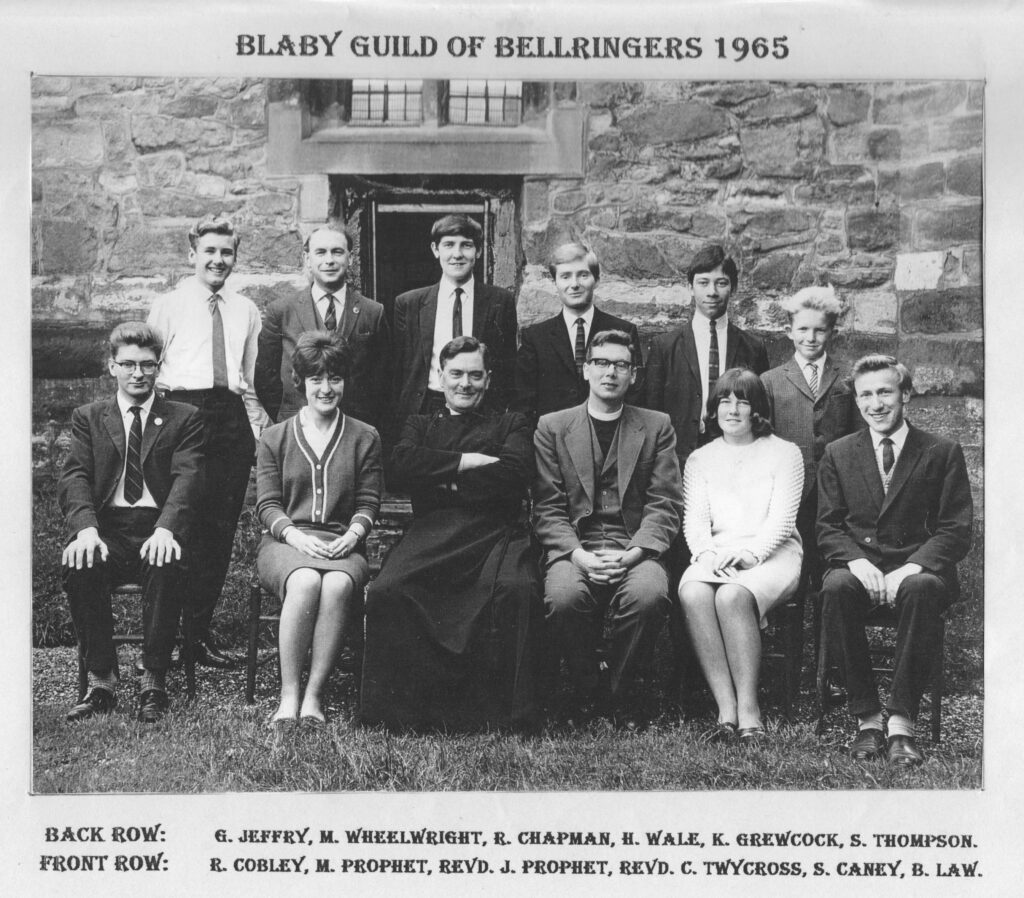
My instructor was the tower’s ringing master, Brian Law, who would not only become one of my greatest friends and eventually the best man at my wedding. Brian lived with his parents at their home in James Street, Blaby. Like most beginners I felt totally uncoordinated with having to learn how to do “back strokes” and “hand strokes” and control the bell so that I didn’t commit the ultimate sin of “breaking a stay”. I soon learned that bellringing has a language of its own and realised that a non-ringing bystander listening to a group of experienced ringers chatting amongst themselves would find the conversation totally incomprehensible.
Despite the initial confusion and with much perseverance I soon got the hang of it and was pleased when I first managed to reach my first milestone of ringing my bell in rounds. From there I progressed to exploring the mysteries of change-ringing, which meant ringing your bell on a fixed path through the other bells. I do not propose to write at length about the intricacies of change-ringing, but sufficient to say that, like many people, I had several misconceptions about bellringing and soon discovered that the art and science of change-ringing was far more complex than I could have ever imagined.
At the time I started ringing at Blaby in the early 1960s there would have been about eight to ten other bellringers. One of these ringers was a lad called Richard Cobley, who lived with his parents in Hospital Lane, Blaby. Richard also became a close friend of mine, and in the ensuing years Brian, Richard and myself would have some enjoyable times together sharing our mutual interests.
In Moat Street, Wigston Magna, where I lived, there are two centres of religion. Topping the hill at the western end of the street with its fine spire is the imposing fourteenth-century All Saints Church. At the street’s eastern extremity was the c1896 Victorian-style Primitive Methodist Chapel (now simply ‘Wigston Magna Methodist Church’), built in distinctive yellow brick. My mother had a long association with the Methodist Chapel and since my early childhood I had attended the Sunday School and later the Youth Club. After I started bellringing at Blaby I can recall one of mother’s Methodist friends saying to me: “Oh, Ronnie, I hear you’ve left us and gone over to the other side.” In actual fact I suppose you could really say that in terms of religion I had simply moved from the chapel in the valley to the church on the hill.
As I progressed with my ringing I soon discovered that apart from the serious business of learning to ring the bells proficiently for Sunday services there was also a very strong social tradition attached to bellringing. While many of the Blaby ringers did not go to church after morning ringing, it was customary for most of us to attend the evening service. I did not usually ring for the morning service because I had to travel from Wigston, but I soon started a regular habit of travelling to Blaby on Sunday afternoons to ring for evensong. I usually caught the L15 Midland Red bus from outside my house, which took me directly to Blaby via South Wigston.
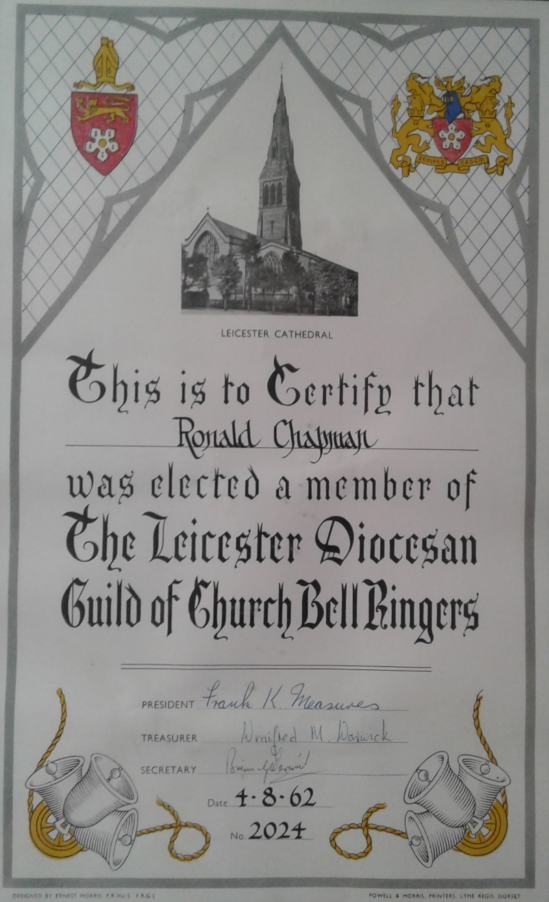
By mid-1962 I had become proficient in my bell handling and was able to ring some basic change-ringing “methods” as they were called. By reaching this standard I had become eligible to join the Leicester Diocesan Guild of Church Bellringers, and in August 1962 I was duly elected a member at one of the district meetings.
After I managed to become proficient at bell handling and ringing some simple changes I started travelling to other local towers. This had the attraction of not only providing me with the opportunity to get used to ringing on different rings of bells but also the added benefit of meeting other ringers in a social setting. This “social setting” was traditionally a visit to the local public house after the evening practice session.
I also began attending monthly meetings of the Leicester Diocesan Guild of Church Bellringers, which were held on Saturdays at various towers. The meeting venues and times held in each of the six Leicestershire districts were advertised every week in the bellringing national publication, The Ringing World, which also contained the latest news about ringers and ringing, plus records of change-ringing achievements. A typical programme for a meeting day would be a bellringing session in the afternoon followed by a church service, an afternoon tea and a formal business meeting. There would probably be more ringing after the meeting and then the highlight of the day – a social get-together at a local hostelry. I distinctly remember attending a Guild meeting held in Kibworth sitting in the pub sipping a most enjoyable, but for me at that time, illegal, pint of Watney’s Draught Red Barrel. So you can perhaps appreciate that weekend ringing meetings could be exhausting yet most refreshing occasions!
The most important social event of the year was the Guild Annual Dinner, which I seem to recall was held in November. The venue changed from year to year and the event was usually held in a well-known pub that had a large function room. I cannot remember too much about these grand occasions, due to both the passage of time and the effects of too much refreshment, although I do have a vague recollection of myself and some of my ringing friends sampling the delights of some Benedictine liquor with unfortunate results. As with many of these functions I often wonder how we ever got home in one piece!
My ringing skills were progressing well and I soon found myself starting to ring quarter peals and peals. For the uninitiated these are specific lengths of changes which are usually rung for special occasions, but in our case we sometimes rang just for the challenge. Depending on the weight of the bells, a quarter peal usually takes about fifty minutes, and a full peal can tale well over three hours continuous ringing. In the early to mid-1960s I spent much of my spare time travelling around the countryside with a group of bellringing friends ringing quarter peals and peals at various church towers.
Sometime in 1964 I read in our local Wigston newspaper an item about the ringers at All Saints Church in Wigston Magna, which is the Church of England church at the top of Moat Street and the one I visited as part of my education at All Saints Junior School in Long Street. The article in the newspaper mentioned that the ringers at All Saints were short of members and called for support from other bellringers or those willing to learn. I felt a little guilty when I read this, because here was I, a fairly competent ringer, who lived just down the hill from the church and I had not even rung the bells in my local tower! I decided to immediately remedy this situation and went along to their next Friday night practice session and introduced myself.
I quickly found out that at All Saints, Wigston I was among a team of very experienced adult ringers with a long and strong family bellringing tradition. The Carter family were most prominent, with Joe, his son Richard and wife Maureen, closely followed by Ted Harrold and his son, John. I also soon became aware that ringing at Wigston Magna was taken much more seriously by these older ringers than was the case with our younger, more relaxed and carefree approach at Blaby! After I had been to the Wigston practice I told my friends Brian and Richard about my experience and they decided they would also go along with me to see what it was like.
We discovered change ringing at All Saints, Wigston to be on a much more complex level than we were used to, but at the same time appreciated that this presented a great opportunity for us to advance our knowledge. When the All Saints ringers saw that the three of us were keen to attend their practices on a regular basis they very kindly offered to teach us how to ring advanced “Surprise Major” methods on their beautifully-sounding ring of eight bells.
In retrospect I view the time I spent ringing with the All Saints, Wigston Magna team of ringers as a period that enabled me to really advance my bellringing skills and to become confident in learning and ringing more complex forms of change ringing. I shall be eternally grateful to the 1960s Wigston Magna All Saints Church bellringers for sharing with me their knowledge and companionship.
Looking back over the years I can now appreciate how bellringing has played such a big part in my early life and opened up so many opportunities for me. It is a stimulating and challenging activity that has provided me with a network of good friends in whose company I have shared many happy hours of social enjoyment. In fact I have always said that the social side of bellringing is equally as important as ringing itself. Ironically my school friend Alan Ward, who introduced me to ringing, decided not to continue with it soon after we started learning to ring at All Saints Church, Blaby.